
 Link has been copied to clipboard
Rotary Switches
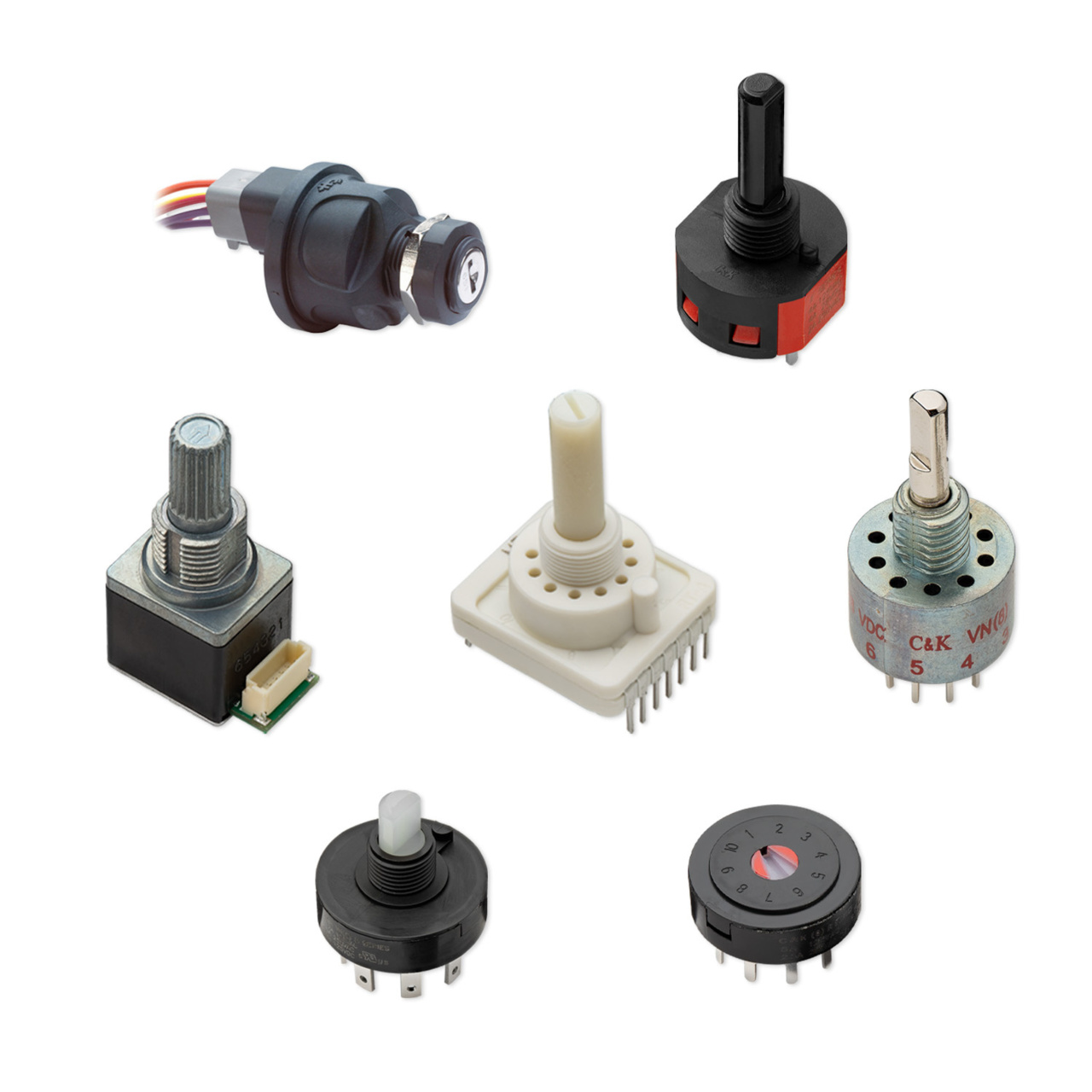
Our rotary switch portfolio supports a wide range of electronic, industrial, and commercial vehicle applications, with options spanning low-level signal switching to higher current control.
C&K® rotary switches are available in a variety of indexing options for applications ranging from 10 mA to 12 amperes. With switchlock, multi-pole, multi-position, half-inch, rota-slide, power rota-slide, and sub-miniature switch type designs, C&K rotary switches feature shorting and non-shorting contacts for maximum design flexibility. Miniature and subminiature designs save space on PCBs, while solder lug, PC through-hole, wire lead, or quick connect terminations support a variety of mounting options.
Low-voltage rotary switch options in our automotive and commercial vehicle lineup include a variety of 12-volt to 24-volt rotary switch types, such as universal rotary switches, electronic rotary dimmer switches, reversing switches, rotary headlamp and light switches, and special-purpose rotary switches. You will find sealed rotary switch options and various actuators like levers, keys, and printed knobs for special applications.
- Multi-pole and multi-position rotary switch options
- Available for 12 V to 24 V systems as well as 10 mA to 12 A applications
- Multiple indexing options with shorting and non-shorting contacts
- Sealed and switchlock rotary switch models available
- Various actuators, including levers, keys, and printed knobs
Rotary Switches Parts
Link has been copied to clipboard Filters
Rotary Switches Applications
- General industrial and electrical equipment
- Building solutions
- Data center and communications solutions
- Consumer electronics solutions
- Transportation
- Health care solutions


Rotary Switches Featured Products
Rotary Switches Support
Frequently Asked Questions
View all relevant FAQsContact us
What are rotary switches?
Rotary switches are operated by rotating the actuator, which may be a knob, lever, or key, depending on the model of the switch and its application. Rotary switches can be two-position on/off or reversing switches or multi-position switches that allow variable control of a load. For example, multi-position rotary switches may be used for dimmable lights with distinct
How do rotary switches work?
Rotary switches make or break electrical connections by the closing or opening electrical contacts as a spindle rotates. Terminals are typically placed around the spindle at fixed rotation intervals, determining the number of available switch positions. There are many different rotary switch designs, including single-pole, single-throw (SPST) rotary switches, rotary